
Ducati’s MotoE project, how will this work?
In October of 2021, at the Misano World Circuit Marco Simoncelli, Ducati made an official announcement stating that they were to become the single manufacturer of the all-electric, single-make MotoE series from 2023 with a contract spanning until 2026, taking over from existing supplier Energica who had supplied their Ego machines to the series since its inaugural season in 2019.
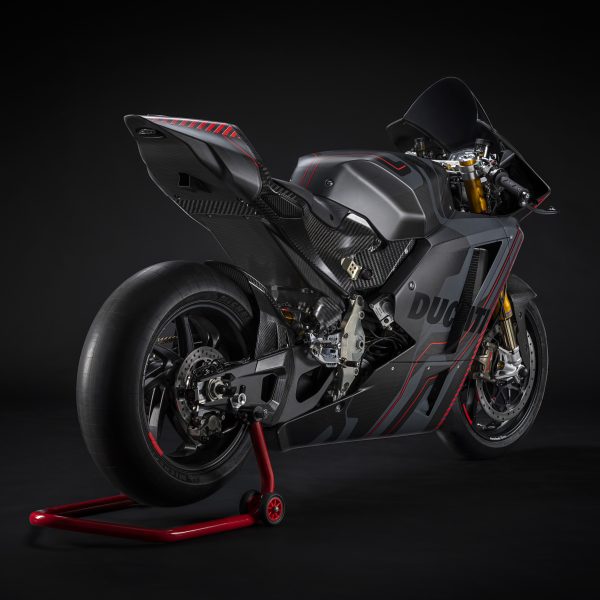
This is the first time in Ducati’s rich history that they will be the sole official supplier in a world championship, doing so with a completely new motorcycle designed specifically for this series, named the Ducati V21L.
How Did Ducati Develop Their Motoe Bike?
Ducati has the infrastructure and access to facilities that no other motorcycle manufacturer possesses in-house; this is largely thanks to its owners, Audi, who purchased the brand through their Italian subsidiary Lamborghini, owned by Volkswagen.
We do not need to go into specific details as to why this benefits their growth, as the names of Audi and Lamborghini should speak for themselves.
These brand partnerships open many doors for Ducati and allow them to utilise some of the world’s best engineers and designers, who work tirelessly to create each part of the motorcycle to meet the desires and needs of Ducati and its riders. The facilities they have access to include test tracks, air tunnels, and simulators, giving test riders and test teams all the resources they could need to create this new era of motorcycles.
Ducati’s approach has been to completely rebuild a new motorcycle from the ground up and produce technological innovation instead of trying to change or adjust the existing formula for a MotoE motorcycle.
Innovation is something Ducati is famous for in MotoGP; they are always pushing the envelope on what is possible, being the first to put aerodynamic wings on their motorcycles and adopt devices that force the motorcycle’s suspension to compress on straights, turning the motorcycle into a drag machine, increasing top speeds while reducing drag.
For their MotoE machine, they have developed top-secret solutions to improve the battery pack, motor, and inverter in their own unique Ducati manner.
Ducati chooses weight over power.
The Energica Ego motorcycle was a good start for the MotoE series; it had enough power, handled well, and could be ridden by all types of riders, with Maria Herrera, who is 1.62 m (5’3″) tall and weighs 54 kg, piloting the machine since the 2019 premier season and having no issues racing against taller, stronger riders, achieving a best result of P5.
For 2023, Ducati wanted a change. The Energica Ego weighed a tremendous 260 kg thanks to its battery pack, which meant for some riders it was a struggle to tame the beast. Therefore, when Ducati took over the project, they opted to reduce the weight before looking to increase power.
In the official announcement, Ducati CEO Claudio Domenicali said, “The area of weight, which is a fundamental element of sports bikes, will prove the greatest challenge.”
“Lightweight machinery has always been in Ducati’s DNA, and thanks to the technology and chemistry of the batteries that are evolving quickly, we are sure that we can achieve excellent results.”
When the official specs were released, Ducati wasn’t lying; the new Ducati V21L weighs significantly less than its predecessor at 225 kg, which is 12 kg less than the minimum requirements imposed by Dorna and FIM for a bike capable of completing the race distance.
The 200+ kg weight is expected to hang around slightly longer until battery technology is improved, with Ducati’s new battery coming in at a beefy 110 kg, making up nearly 50% of the total weight of the motorcycle. Interestingly though, the battery also acts as a stress part of the chassis with a carbon fibre casing surrounding it, much like the Ducati Panigale V4 engine.
What are the Ducati V21L specs?
The Ducati V21L is a speedy thing despite its weight and achieved 275 km/h (170 mph) at Mugello. The engine produces 110 kW of power (150 hp) and 140 Nm of torque, which can be applied the second the throttle is opened thanks to the characteristics of a battery-powered engine; these figures mean that it can keep up with a Ducati Desmosedici on acceleration, well, for a little while anyway.
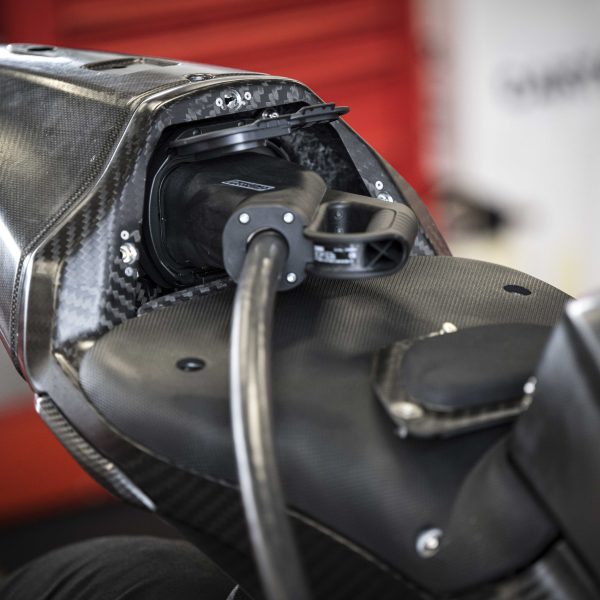
The battery pack offers a capacity of 18 kWh with a 20-kW charging socket integrated into the tail of the motorcycle just under the seat; within the battery, there are 1,152 cylindrical cells of the “21700” type.
Not sure what a “21700” cell is? Me neither. A quick search on my chosen search engine revealed that they are rechargeable lithium-ion cells that are used to power various devices, it is named the “21700” as it is 21 mm in diameter and 70 mm in length. Ducati’s battery has 1,152 of them! No wonder it’s so heavy.
The inverter weighs 5 kg and employs technology from electric car racing thanks to Audi’s influence; their RS e-tron GT is one of the fastest electric cars on the market.
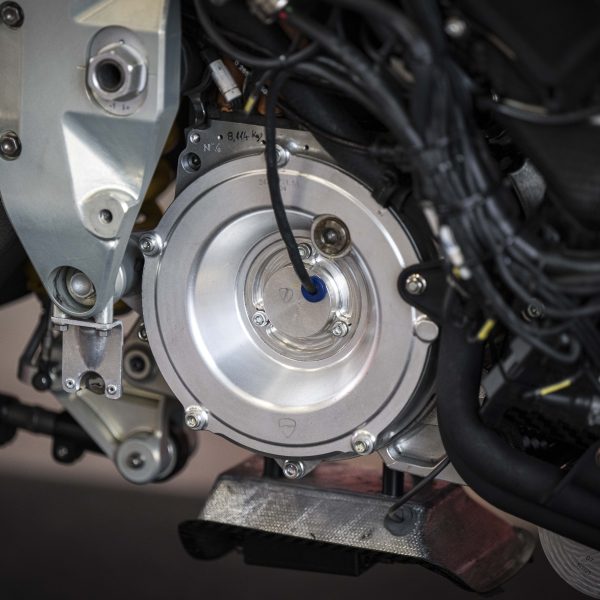
The 21 kg motor for the engine has a maximum rotation speed of 18,000 rpm and was once again developed by one of Ducati’s parent companies to the specs provided by the brand.
This entire circuit and engine are powered by 800 volts, which increases output and speeds.
Additionally, the motorcycle contains a sophisticated and efficient liquid system with a double circuit to meet the thermal needs of the motorcycle, cooling the battery pack, motor, and inverter in the process.
How has the Ducati MotoE bike performed on track?
Ducati enlisted the assistance of their test team of riders, namely Alex De Angelis, Michele Pirro, and Chaz Davies, a trio of experienced riders from different disciplines, with Pirro notable for his work as a test rider with the Ducati MotoGP Team, completing multiple wildcards a season; Chaz Davies, a longtime Ducati rider in the World Superbikes series, and Alex De Angelis, an ex-MotoGP, World Superbikes, and more recently MotoE rider, competing in the series in 2019 and 2020, with relevant and accurate knowledge of how the new bike compares to its predecessor and what characteristics it should possess.
The Ducati V21L first took to the track at the Misano World Circuit Marco Simoncelli in December 2021 and has significantly improved since this date following extensive analysis of data and rider feedback to aid improvements and steer the motorcycle in a positive direction.
The bike has been tested numerous times since this date in private tests at tracks across Italy, including Mugello and Vallelunga, and has looked to adopt MotoGP methodologies and physicalities with the input of their test riders, all three of whom have ridden MotoGP bikes previously.
Will Ducati create a road-legal electric motorcycle?
Simply put, yes, this is the goal. In his official statement, Claudio Domenicali concluded by saying, “I am convinced that, once again, we will treasure the experience we gain in the world of competition in order to transfer and apply it to production motorcycles.”
The world is changing, and manufacturers from BMW to Kawasaki to Harley-Davidson are producing road-legal electric motorcycles with more and more manufacturers getting a piece of the electric pie year after year. Ducati wants their own slice or, more likely, the entire pie to themselves.
It’s hard to doubt that Ducati is using the MotoE series as a way to improve its own technology and apply it to road-legal motorcycles. The best, fastest, and most efficient manner to do so would be to have 19 top-level riders thrash them around on track for 16 races over eight rounds for three years, which is exactly what they are doing.
Ducati V21L Image Gallery
Here are some images of Ducati’s new exciting motorcycle.
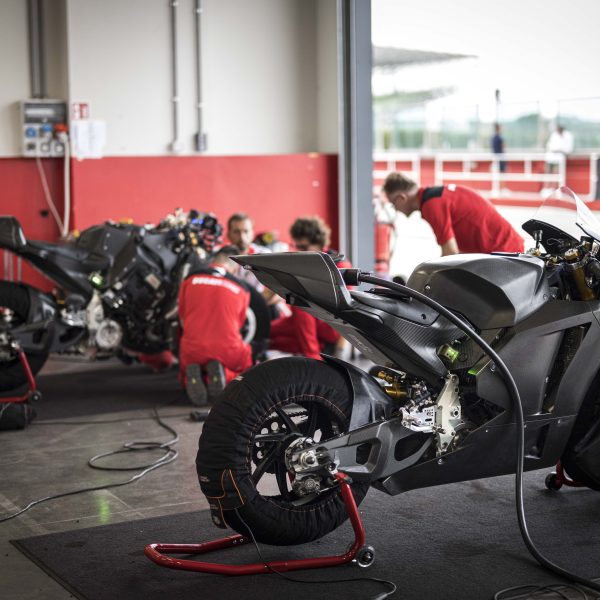



Ducati MotoE Pits
Ducati MotoE Battery
Ducati MotoE Motor
Ducati MotoE Charging
Ducati MotoE Side
Ducati MotoE Front
Ducati MotoE On Track
Ducati MotoE Back Side